

Beyond Super Tuscans: elegance and terroir in the vision of Ilaria Tachis
Arriving at Podere La Villa, nestled in the hills of San Casciano on a May morning already warm after a week of intense rain, I am greeted in the cellar by Ilaria Tachis. From the very first moment, one is struck by the cordiality, hospitality, and simplicity with which she receives you. It is an almost surprising sensation, considering the history and the weight of the surname she carries. Yet the immediate impression is one of being welcomed naturally, as a guest in her own home.
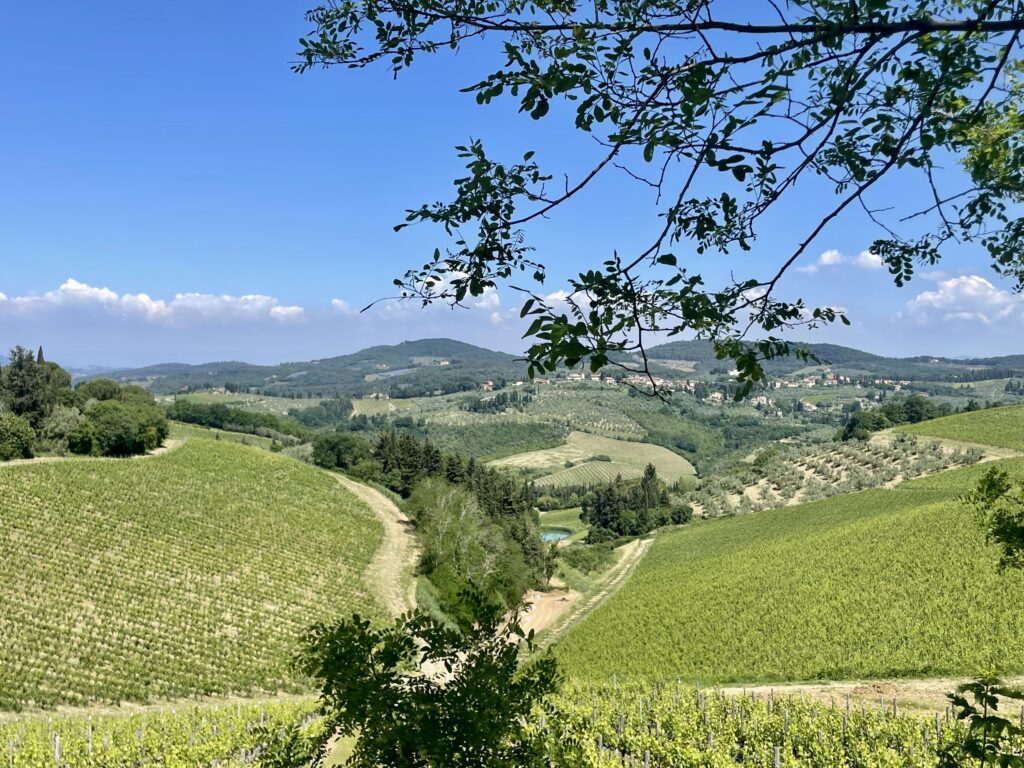
The valley where Podere La Villa is located has something truly special about it. The hills open into a natural basin, with vineyards descending toward a lake that closes the landscape at the bottom of the property. It is a breathtaking postcard, rendered even more unique by the intense luminosity that envelops the entire valley and by soils rich in clay and large river pebbles, capable of retaining heat in a way different from other areas of the Chianti Classico. Walking through the rows together with Ilaria, the conversation naturally shifts to her idea of wine and the profound relationship that binds these vineyards to the surrounding territory.
The special thing about this place is not just the landscape, but the way it is experienced. Everything happens with a rare naturalness, without forced formalities or staged welcomes. At one point, we sit on a brick-red bench overlooking the valley, with an incredible view of the vineyards and the lake in front of us. And perhaps one of the most beautiful moments of the interview is that very shared silence, so simple yet at the same time so full. It is not just about talking about wine, but pausing to observe the landscape, listening to the countryside, and letting yourself be taken by that calm which manages to transform certain moments into memories.
One of the vineyards that left the greatest impression on me is certainly the old Merlot, planted over forty years ago. As you enter, the landscape changes suddenly. You walk between the rows and, after a few meters, you encounter a very pronounced, almost unexpected slope, which even gives a slight sense of vertigo. The vineyard seems to open up suddenly before your eyes, ending against an area of woodland that is part of the property. It is a place that conveys a sense of great balance and freshness, above all due to the continuous relationship between the valley's exposure, the sharp temperature fluctuations between day and night, and the proximity of the woods surrounding that part of the estate.
One of the most beautiful things during the tour is the naturalness with which Ilaria accompanies you through her home, the cellar, and the vineyards. There is nothing constructed or distant. Everything is experienced with simplicity, in the daily relationship with the people who work alongside her and share the same idea of wine. More than a business built on luxury or status, Podere La Villa conveys, above all, a strong human dimension.
Ilaria explains that from the very beginning, one of her priorities has been hospitality. Over the years, she has gained experience both in other wineries and directly at her own home, embarking on a path closely linked to the world of hospitality. And perhaps it is also for this reason that today she considers authenticity and hospitality to be two inseparable elements in the way one talks about wine. For her, above all else, wine remains conviviality.
Bearing the Tachis surname inevitably means living with an important legacy. Giacomo Tachis was not only one of the most influential winemakers in modern Italian wine; he was also a constant presence in her daily life.
Her own journey, however, did not begin in oenology. From a young age, she felt much closer to the world of languages, literature, and art history. Yet wine has always been a part of her life. It is something her father passed on to her naturally, through childhood memories that she still recounts today with great affection. Moments that were never monotonous, but filled with experiences, encounters, and lessons that even now, when she recalls them, still bring a smile to her face.
The more technical part of her journey came later, almost spontaneously, beginning with working on translations, interviews, and documents related to her father's work, eventually collaborating with other wineries over time as well.
Alongside her today is also Alessandro Cellai, a long-time collaborator of Giacomo Tachis.
There is also a detail that tells us a great deal about the meaning of this project: despite having changed the history of Italian wine with Sassicaia and Tignanello, Giacomo Tachis never had a winery of his own.
When the time came to decide what to do with the old family vineyard, he initially advised renting it out.
She, on the other hand, chose to produce wine.
The moment Podere La Villa was truly born arrived with the first bottles of Pargolo. And it is precisely while talking about that period that Ilaria shares one of the funniest episodes of the interview. At first, Giacomo Tachis had even advised her not to enter the production world, but when he tasted the result of the first bottles, he completely changed his attitude. He was so proud of the work his daughter had done that he began giving away almost the entire production to friends and close acquaintances. Ilaria recounts with a smile that she kept telling him those bottles should also be sold, but he mainly wanted to share and show off with enthusiasm the work she had managed to build.
When speaking about wine, Ilaria is very clear about the direction she wants to follow. She does not look for wines built on power, marked by too much wood or excessive intervention that risks distancing the wine from its most natural identity. Her idea leans towards wines that are elegant, alive, and pleasant to drink, capable of leaving space for the fruit and the personality of the grape variety in the territory where it is born. A search that aims, above all, to bring the grape variety to the peak of its expression, without covering its character with technique. Not wines built to impress, but wines that manage to move you. And it is precisely on emotion that she returns often during the conversation, because according to her, it is one of the things that Italian wine still knows how to do better than many other countries.
Even when she talks about the wines she admires, the conversation always returns there. From Angelo Gaja, she appreciates above all the ability to craft wines that are elegant, refined, and never heavy. Of Sassicaia, on the other hand, she speaks as a great example of territorial identity, a wine that is recognizable and profoundly linked to the place from which it is born. Two different aspects, but both very present in the way she imagines her own wines today.
Even the work being done today at Podere La Villa regarding macerations follows this same philosophy. The goal is to obtain wines that are livelier, more drinkable, and less heavy, letting the fruit and the character of the grape variety always remain central. Because, above all, wine must be drunk. It must remain accessible, convivial, and linked to people’s everyday lives.
Regarding communication, a very clear reflection often emerges: according to Ilaria, today wine is talked about too much through marketing and too little through the territory. The starting point, in her idea of wine, should always be the place where everything originates. Even before the bottle or the brand, what matters is telling the story of the vineyard, the daily work, the characteristics of the territory, and the agricultural identity that exists behind every wine.
The conversation naturally also turns to the topic of food culture and the way in which wine is often demonized today. According to her, the balanced, everyday relationship that has always existed in Italian culture has been partially lost. Wine remains a cultural and convivial food, but it must be accompanied by education in moderation, proportion, and more conscious consumption.
At the same time, she looks with optimism at the present state of Italian wine. According to her, one of the most important changes in recent years concerns the qualitative growth of small and medium-sized companies, which are currently working very well on both sustainability and wine quality.
Another fundamental aspect is the recovery of native grape varieties and biodiversity. Italy possesses an enormous heritage which, in her view, must be preserved and valued much more.
Another very interesting topic addressed during the conversation was that of climate change and how it is experienced concretely in the daily work in the vineyard. For Ilaria, climate change does not only concern the wine, but also the people who work in the rows every day. For this reason, one of the priorities is to protect both the vineyards and those who work in the countryside, through reduced hours during the hottest times, differently organized days, and agronomic practices designed to defend the grape clusters from excessive light and heat, for instance by leaving a greater leaf canopy to protect the grapes.
It is a continuous work of observation and adaptation, because every vintage requires different responses. But one of the most interesting things that emerged during the interview is the conviction that even the vine, over time, learns to adapt to new climatic conditions. The vineyards change, evolve, and coexist with the climate in ever-different ways. And it is precisely this capacity for adaptation that today forces producers to innovate continuously in the vineyard, seeking an increasingly careful balance between wine quality, territory, and human well-being.
The winery has always avoided the use of herbicides and glyphosate, and as of 2025, organic certification will officially arrive. But listening to her talk, one understands that sustainability here is not a slogan to be used in marketing. It is simply part of the daily work. This also applies to the people.
One of the aspects she describes with the most enthusiasm concerns teamwork. She likes to surround herself with young people, students, interns, agronomists, winemakers, and people from diverse backgrounds. Everyone contributes to creating that human balance which she today considers fundamental within an agricultural business.
There are also very concrete social projects where some individuals have the opportunity to learn a trade and build a new stability through agricultural work.
The young agronomist Benedetta Del Rosso follows the health of the vineyards with care and brings new energy to the daily work.
And then, finally, the wines arrive. And it is here that everything we have seen and experienced during the visit truly translates into the glass.
The first wine born at the estate was Pargolo, a Chianti Classico symbolically linked to the birth of her first son. It is perhaps the most immediate wine in the range. Fresh, direct, very food-friendly.
Over the years, the idea of a white wine has also been taking shape, still currently in the design phase.
Among the most important labels, however, is Giacomo, a Merlot dedicated to her father. It is born precisely from the old vineyard that overlooks the valley. Here, the fruit remains deep but controlled, accompanied by notes of black cherry, dark plum, Mediterranean herbs, sweet tobacco, and bitter cocoa.
Then there is Expecta, the winery's Chianti Classico Riserva.
It is probably the wine that best tells the story of the winery’s stylistic direction. The Sangiovese maintains energy and tension without becoming heavy. In the glass, black cherry, wild blackberry, pomegranate, black pepper, medicinal herbs, and light floral notes emerge.
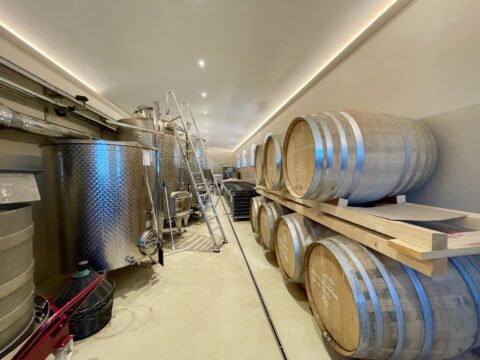
The use of wood remains very measured and interventions in the cellar are kept to a minimum. The wines are almost unfiltered, precisely to leave the identity of the fruit and the vineyard as intact as possible.
After a few hours spent among vineyards, barrels, and stories of the harvest, the sensation is that of having met a producer who is seeking a very personal path.
A path less linked to the excesses that marked part of Tuscan wine in past years and much closer to the land, to drinkability, and to the identity of the territory.
“At the end, everything always returns there: to the territory, to elegance, and to the people. Because for a wine to truly move you, it must manage to tell the story of the place where it originates without losing its authenticity. And perhaps this is precisely the direction that Ilaria Tachis is seeking today: wines capable of reaching the highest expression of the grape variety, without forgetting that wine, above all else, remains conviviality.”
Read more

TERENZUOLA, WHERE TWO TERRITORIES MEET
Between Tuscany and Liguria, between sea and mountains: a borderland where wine takes a path all its own. There are wineries where the visit begins when you park. At Terenzuola, however, it star...
Read more